
Why Psychology Matters More Than Most People Think
One of the biggest misconceptions about cryptocurrency trading is believing that success mainly depends on finding the perfect strategy or discovering the next coin that will explode in value. In reality, most experienced traders eventually realize that psychology matters far more than technical indicators alone.
The crypto market is extremely emotional by nature. Prices move aggressively, news spreads instantly, and social media constantly amplifies both optimism and panic. Because of this, emotions quietly become one of the biggest reasons why most traders fail.
Many beginners spend months learning chart patterns and indicators, but when real money is involved, fear and greed begin controlling their decisions. Once emotions take over, even good strategies stop working properly because traders abandon discipline completely.
The Emotional Nature of Crypto Markets
Crypto markets behave differently from traditional financial markets because volatility is much higher. Prices can rise dramatically within hours and collapse just as quickly. On top of that, the market never closes. Cryptocurrencies trade 24 hours a day, seven days a week, creating nonstop psychological pressure.
This constant activity makes many beginners obsessed with checking charts every few minutes. Traders become emotionally attached to every movement because they fear missing opportunities or losing money suddenly.
Social media makes this even worse. During bullish periods, platforms like X, TikTok, and YouTube become filled with: profit screenshots, viral predictions, hype around certain coins and unrealistic expectations.
After seeing thousands of people talking about easy money, beginners start believing they must enter the market immediately before prices rise even more.
How FOMO Destroys Traders
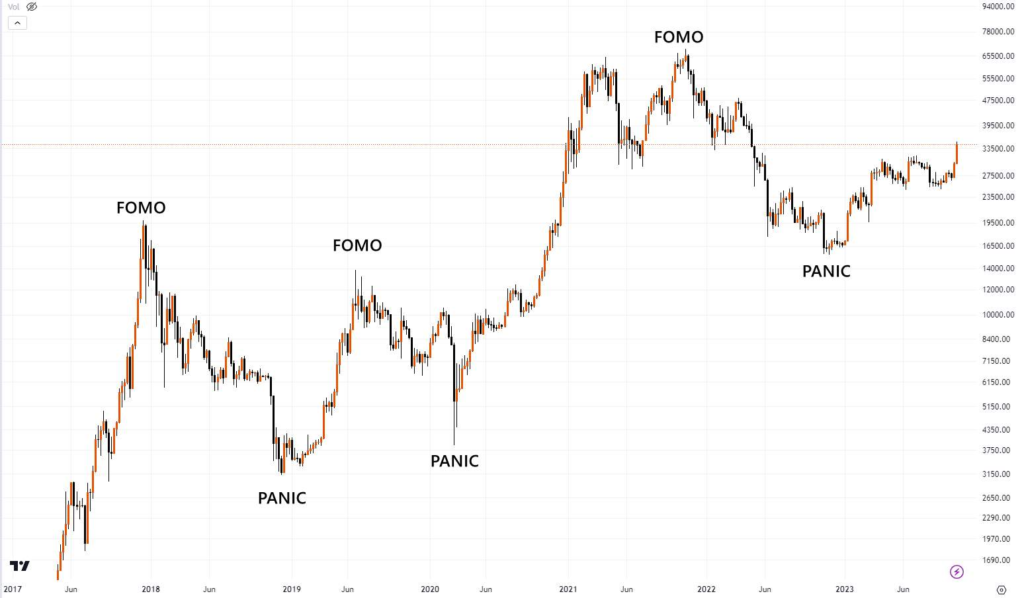
Fear of missing out, commonly known as FOMO, is one of the most dangerous emotions in crypto trading.
When traders see a coin pumping aggressively, logic often disappears. Instead of analyzing risk properly, they buy emotionally because they are afraid of missing life-changing profits.
Ironically, this usually happens near local tops when experienced traders are already taking profits.
FOMO creates terrible decision-making because urgency replaces patience. Traders stop following plans and begin chasing excitement instead. In many cases, people enter positions they barely understand simply because social media convinced them everyone else is getting rich.
Professional traders usually understand that opportunities never disappear permanently. The market always creates new setups. Beginners, however, often feel that every pump is their “last chance.”
Panic Selling During Market Crashes
Fear works in the opposite direction during bearish markets.
When prices collapse aggressively, panic spreads extremely fast across the crypto community. News headlines become negative, influencers disappear, and social media suddenly turns pessimistic.
Many beginners sell emotionally after huge declines because they can no longer handle the pressure of watching losses grow.
The problem is that panic selling often happens after most of the damage already occurred. Emotional reactions force traders to buy high during excitement and sell low during fear, which is exactly the opposite of what successful investing requires.
Experienced traders understand that volatility is normal in crypto markets. They know market cycles constantly change between bullish and bearish phases. Beginners, however, often react emotionally to every major movement because they lack experience dealing with uncertainty.
Greed and Overconfidence
Greed destroys traders just as much as fear does.
After a few successful trades, many beginners begin believing they fully understand the market. This overconfidence usually leads to: larger position sizes, excessive leverage, impulsive entries and poor risk management.
Bull markets are especially dangerous because rising prices create the illusion that trading is easy. During euphoric periods, almost everything goes up, which makes inexperienced traders feel smarter than they really are.
Many people who make fast money during strong bull markets eventually lose everything because they stop respecting risk completely.
Professional traders think very differently. Instead of focusing only on profits, they focus heavily on protecting capital and surviving long term.
The Problem With Revenge Trading
Another emotional trap that destroys many traders is revenge trading.
After taking losses, some traders become obsessed with recovering their money immediately. Instead of staying calm and patient, frustration begins controlling their decisions.
This usually creates a dangerous cycle:losses create anger – anger creates impulsive trades – impulsive trades create even more losses.
At that point, trading stops being logical entirely. It becomes emotional gambling disguised as strategy.
Successful traders understand that losses are a normal part of trading. Even strong strategies lose sometimes. The difference is that experienced traders remain disciplined instead of reacting emotionally after bad trades.
Why Patience Is a Huge Advantage
One of the biggest differences between beginners and experienced traders is patience.
Most new traders feel the need to always be active in the market. They constantly search for trades because they believe successful traders are making moves all day long.
In reality, professional traders often spend more time waiting than trading.
They understand that avoiding bad trades is just as important as finding good ones. Sometimes the smartest decision is simply doing nothing until market conditions improve.
Patience becomes a massive advantage because emotional traders usually destroy themselves through overtrading and impulsive behavior.
Learning Emotional Discipline
Emotional control is not something traders develop instantly. Most people only improve psychologically after experiencing: losses, volatility, frustration and difficult market conditions.
These experiences slowly teach discipline over time.
Using tools such as TradingView can help traders become more analytical and less emotional, but tools alone are never enough. Psychology remains one of the most important parts of long-term success.
The traders who survive usually understand that crypto trading is less about excitement and more about consistency, patience, and self-control.
Final Thoughts
In crypto trading, emotions often become more dangerous than the market itself. Fear, greed, impatience, and overconfidence repeatedly destroy traders who fail to control their psychology.
The biggest difference between beginners and experienced traders is usually not intelligence or technical knowledge. It is the ability to stay calm while everyone else becomes emotional.
Successful crypto trading is rarely about chasing hype or finding guaranteed profits quickly. It is about managing risk intelligently, controlling emotions during volatility, and remaining disciplined long enough to survive and improve over time.